When parents picture a great education, they often think about a strong diploma, a good university, and a promising career. But the skills that carry a child through life begin developing long before college applications.
A young child learning to wait for their turn is building self-control. A confident reader gains access to new ideas. A teenager taking on challenging coursework develops greater independence. Each stage builds on the one before.
From Pre-K to Grade 12, an American education connects these everyday learning experiences with a longer journey: helping children become capable learners, thoughtful individuals, and young adults ready for their next steps.
Early Childhood (Ages 3–5): Learning Through Play
A good preschool experience is about more than getting an early start on worksheets. It helps children learn to focus, wait for their turn, and manage their impulses. Harvard’s Center on the Developing Child describes these as executive function skills, which develop through practice and supportive experiences.
Play gives children valuable opportunities to practise them. The American Academy of Pediatrics highlights how play supports brain development, executive function, and social-emotional skills, even recommending a “prescription for play.” NAEYC also supports playful learning that builds on children’s strengths and curiosity.
The benefits can extend well beyond preschool. Research led by Nobel laureate James Heckman estimated a 13% annual return on investment in two intensive early childhood programs serving disadvantaged children in North Carolina. This reflected long-term benefits across education, health, and employment, rather than a financial return to individual families.
At RAS Jakarta, our Early Childhood program builds on children’s natural curiosity through exploration and discovery. In a nurturing, play-rich environment, young learners develop creativity, early critical thinking skills, and a love of learning.
Elementary School (Ages 6–10): Building Strong Foundations
The elementary years open up a new world for children. As reading becomes more confident, it helps them explore ideas across subjects. A study published by Annie E. Casey Foundation found that children who were not reading proficiently by the end of third grade were four times as likely to miss on-time high school graduation as proficient readers.
Math matters too. Research across six long-term studies found that early math skills were the strongest predictors of later academic achievement, followed by reading and attention skills. These findings highlight why a strong foundation in both literacy and math matters. These years are also about learning how to learn. Asking questions, testing ideas, and doing a difficult task help children become more confident, independent learners.
At RAS Jakarta, our elementary program focuses on literacy and math through hands-on learning. Students develop critical thinking and problem-solving skills, while our English Language Programs support children whose first language is not English.
Middle School (Ages 11–13): Growing with Confidence
Middle school brings changes in friendships, expectations, and how children see themselves. Having an adult who knows them well and takes time to listen to matters. The Association for Middle Level Education identifies an adult advocate for every student as a key part of a successful middle school.
That sense of connection can have lasting benefits. A study involving CDC researchers found that strong connections at both school and home during adolescence were associated with 48% to 66% lower odds of several health risks in adulthood, depending on the outcome.
Students are also learning to understand their feelings, manage challenges, build relationships, and make thoughtful decisions. These reflect CASEL’s five areas of social-emotional learning: self-awareness, self-management, social awareness, relationship skills, and responsible decision-making. A review of 213 school-based programs involving more than 270,000 students found that participants performed an average of 11 percentile points higher academically than comparison groups.
At RAS Jakarta, our Middle School supports this transition through daily advisory and counselor support. Students have opportunities to grow academically while building confidence, social-emotional skills, and a positive sense of self.
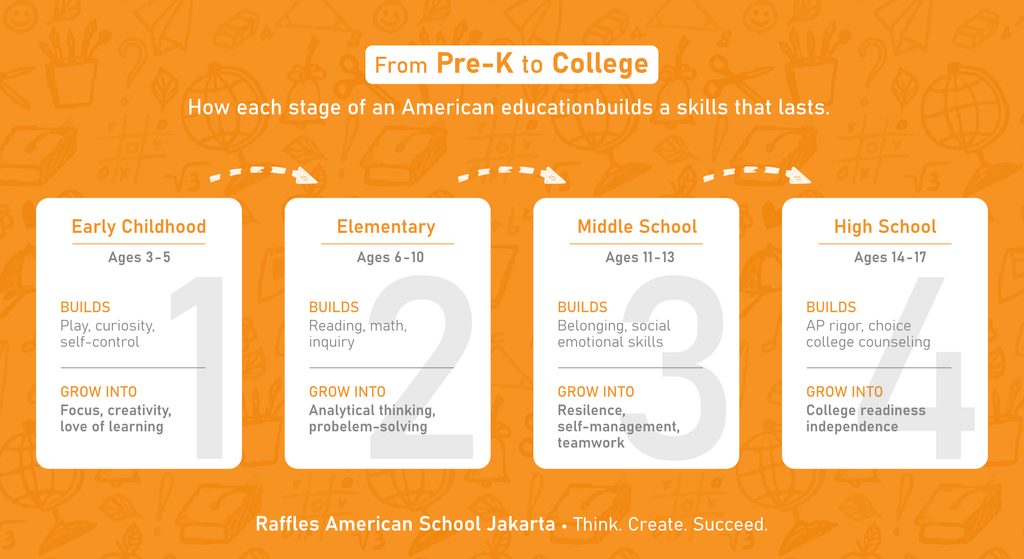
High School (Ages 14–17): Preparing for What Comes Next
High school is a time for students to explore their interests, take on greater challenges, and think about life after graduation. An American education offers both challenge and choice. Advanced Placement (AP) courses give students the opportunity to experience college-level study while still in school. College Board research links participation in AP courses and exams with a greater likelihood of completing a college degree on time.
Challenging coursework also matters in university admissions. In NACAC’s survey covering fall 2023 admissions, approximately 77% of responding four-year colleges rated grades in college-preparatory courses as considerably important. A student’s academic record and the strength of their curriculum were the leading considerations.
For families considering overseas study, the United States hosted approximately 1.2 million international students in the 2024/25 academic year. When exploring university pathways, families should check each institution’s entry requirements and the school’s accreditation status. Accrediting bodies such as ACS WASC assess school quality and ongoing improvement, but accreditation does not guarantee university admission.
At RAS Jakarta, high school students take AP courses and receive guidance from our college counseling team through the University Preparation program, helping them explore their options and plan their next steps.
The Skills That Last Beyond School
No one can predict exactly what jobs today’s preschoolers will have. But research offers a useful picture of the skills employers value. The World Economic Forum’s Future of Jobs Report 2025 identifies analytical thinking as the leading core skill, valued by around seven in ten surveyed employers, alongside resilience, flexibility, and agility.
Employers also look for people who can solve problems and work well with others. In NACE’s Job Outlook 2025 survey, nearly 90% of responding employers sought evidence of problem-solving skills on graduates’ resumes, while nearly 80% looked for teamwork. The OECD’s Learning Compass 2030 adds a broader perspective, highlighting the ability to create new value, reconcile tensions and dilemmas, and take responsibility.
These skills connect three areas identified by the U.S. National Research Council: thinking and reasoning, managing oneself, and working with others. Their foundations develop throughout school. Play helps young children practise self-control and cooperation. Elementary learning strengthens literacy, numeracy, and persistence. Middle school builds relationships and self-awareness, while high school brings greater academic challenge and responsibility.
Skills like these do not appear overnight in Grade 12. They grow year by year, through opportunities to ask questions, try new approaches, and learn alongside others.
Skills like these do not appear overnight in Grade 12. They grow year by year, in classrooms where children are known, challenged, and supported.
Discover Raffles American School Jakarta in Person
Research can tell you what matters. Only a visit can show you whether a school delivers it. One of the most well-known education experiments in the United States, Tennessee’s Project STAR, discovered that students in smaller early-grade classes outperformed peers in larger classes (Mosteller, 1995). Follow-up research found that those students’ early classroom experiences were associated with higher adult college attendance rates (Chetty et al. 2011). In other words, the small details in a classroom add up over time.
That is why we invite you to view ours. Raffles American School Jakarta will open on Saturday, December 5, 2026, at its campus in Lippo Thamrin, Central Jakarta. During one relaxed, no-pressure visit, your family can:
- Take a tour of campus and visit the classrooms that your child will use on a daily basis.
- Meet our Head of School, Mr. Patrick Mayo, and learn how we deliver an American education in Jakarta.
- Attend a university counseling session with a counselor from our Malaysian campus.
- Book a one-on-one admissions consultation to discuss grade placement, English language support, the application process, and fees.
- Let your child participate in hands-on activities led by our teachers while you explore.
A one-time offer for Open House families: Families who attend and enrolll on December 5 will receive a scholarship tuition discount. Full information will be provided on the day.
Whether your child is starting Pre-K or getting ready for university, this is the simplest way to see every step of the journey in one place.
Register for the Open House · Chat with Admissions on WhatsApp · Send an inquiry
Think. Create. Succeed. We look forward to welcoming you.
Head of Marketing
Raffles American School Jakarta
References
ACS WASC. (n.d.). ACS WASC overview. Accrediting Commission for Schools, Western Association of Schools and Colleges. https://acswasc.org/about/acs-wasc-overview/
American Academy of Pediatrics. (2018, August 20). Want creative, curious, healthier children with 21st century skills? Let them play, according to the American Academy of Pediatrics. HealthyChildren.org. https://www.healthychildren.org/English/news/Pages/healthier-children-play-according-to-the-aap.aspx
Bishop, P. A., & Harrison, L. M. (2021). The successful middle school: This we believe. Association for Middle Level Education. https://www.amle.org/Shop/ThisWeBelieve.aspx
Center on the Developing Child at Harvard University. (2011). Executive function: Skills for life and learning (InBrief). https://developingchild.harvard.edu/wp-content/uploads/2024/10/InBrief-Executive-Function-Skills-for-Life-and-Learning-2.pdf
Centers for Disease Control and Prevention. (2019, June 24). Adolescent connectedness and adult health outcomes [Press release]. https://www.cdc.gov/nchhstp/newsroom/2019/adolescent-connectedness-press-release.html
Chetty, R., Friedman, J. N., Hilger, N., Saez, E., Schanzenbach, D. W., & Yagan, D. (2011). How does your kindergarten classroom affect your earnings? Evidence from Project STAR. The Quarterly Journal of Economics, 126(4), 1593–1660. https://doi.org/10.1093/qje/qjr041
Collaborative for Academic, Social, and Emotional Learning. (n.d.). What is the CASEL framework? https://casel.org/fundamentals-of-sel/what-is-the-casel-framework/
College Board. (n.d.). Discover the benefits of AP. AP Central. https://apcentral.collegeboard.org/about-ap/launch-grow-ap-program/discover-benefits
Duncan, G. J., Dowsett, C. J., Claessens, A., Magnuson, K., Huston, A. C., Klebanov, P., Pagani, L. S., Feinstein, L., Engel, M., Brooks-Gunn, J., Sexton, H., Duckworth, K., & Japel, C. (2007). School readiness and later achievement. Developmental Psychology, 43(6), 1428–1446. https://doi.org/10.1037/0012-1649.43.6.1428
Durlak, J. A., Weissberg, R. P., Dymnicki, A. B., Taylor, R. D., & Schellinger, K. B. (2011). The impact of enhancing students’ social and emotional learning: A meta-analysis of school-based universal interventions. Child Development, 82(1), 405–432. https://doi.org/10.1111/j.1467-8624.2010.01564.x
Gray, K. (2024, December 9). What are employers looking for when reviewing college students’ resumes? National Association of Colleges and Employers. https://naceweb.org/talent-acquisition/candidate-selection/what-employers-seek-on-a-resume
Hernandez, D. J. (2011). Double jeopardy: How third-grade reading skills and poverty influence high school graduation. The Annie E. Casey Foundation. https://www.aecf.org/resources/double-jeopardy/
Institute of International Education. (2025, November 17). United States hosts 1.2 million international students at colleges and universities, totaling 6% of U.S. higher education [Press release]. https://www.iie.org/news/open-doors-2025-press-release/
Mosteller, F. (1995). The Tennessee study of class size in the early school grades. The Future of Children, 5(2), 113–127. https://doi.org/10.2307/1602360
National Association for College Admission Counseling. (n.d.). Factors in college admission. https://www.nacacnet.org/factors-in-college-admission/
National Association for the Education of Young Children. (2020). Developmentally appropriate practice [Position statement]. https://www.naeyc.org/resources/position-statements/dap/contents
National Research Council. (2012). Education for life and work: Developing transferable knowledge and skills in the 21st century. The National Academies Press. https://doi.org/10.17226/13398
Organisation for Economic Co-operation and Development. (2019). OECD Learning Compass 2030: Concept note. https://search.oecd.org/education/2030-project/teaching-and-learning/learning/learning-compass-2030/OECD_Learning_Compass_2030_concept_note.pdf
University of Chicago News Office. (2016, December 12). Investment in early childhood programs yields robust returns. University of Chicago News. https://news.uchicago.edu/story/investment-early-childhood-programs-yields-robust-returns
World Economic Forum. (2025). The future of jobs report 2025. https://www.weforum.org/publications/the-future-of-jobs-report-2025/
Yogman, M., Garner, A., Hutchinson, J., Hirsh-Pasek, K., Golinkoff, R. M., Committee on Psychosocial Aspects of Child and Family Health, & Council on Communications and Media. (2018). The power of play: A pediatric role in enhancing development in young children. Pediatrics, 142(3), Article e20182058. https://doi.org/10.1542/peds.2018-2058